
The Oilfield Technology Company


Field Gas Conditioning for Production Facilities
Use of raw field gas as a fuel source for production facility equipment can cause equipment downtime, increased maintenance costs and lost production, while also carrying a high environmental impact. Conditioning the field gas prior to use can resolve these issues, turning raw field gas into high quality fuel that will provide significant savings, operational benefits and reduced emissions.

On-Site Fuel Use in Production Facilities
At a typical oil pad surface facility, multiphase well fluids first flow into a two- or three-phase separator where free gas flashes off, oil rises, and produced water settles by gravity. This initial separation step is often followed by additional steps (heater treaters, phase separators, gas busters, Vapor Recovery Towers) where pressure is reduced, heat is applied, and residence time is used to achieve further separation. The heat applied in these steps is typically through fired burners using raw field gas as fuel. Multiple gas streams produced in separators are often at pressures below midstream evacuation pressure, requiring compressors to boost gas to sales line pressure. These compressors are often engine driven, and these combustion engines also typically use raw field gas as fuel. Additional equipment such as flare pilots, VRUs and gas lift compressors also rely on raw field gas as a readily available on-site fuel source.


Challenges with Raw Field Gas as Fuel
Raw field gas, in its untreated form, is typically a very low-quality fuel for production facility equipment such as fired heaters, compressors and pilots. The field gas often contains significant quantities of heavy (C3+) hydrocarbons, has appreciable water present, and tends to vary in composition, pressure and temperature over time. In fired heaters, variation in heating value can result in poor burner tuning, flame instability and inconsistent performance. Entrained liquids can result in slugs that lead to flameout, sooting, fouling and damage to regulators and control valves, while entrained water can lead to ice or hydrate formation which can plug pilots and orifices. Pressure variation can result in low fuel pressure trips and difficulty maintaining proper operation.
For compressor engines and equipment pilots, these same issues can result in misfires, rough operation, unstable performance, shutdowns, and increased emissions. The result is significant engine derating, increased maintenance costs, reduced uptime, and lower overall production. In addition, burning raw field gas also consumes valuable heavy hydrocarbons that could otherwise be recovered as NGLs or condensate.
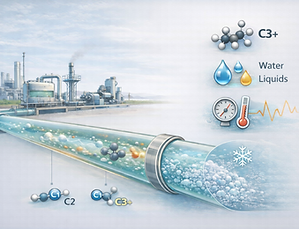
Raw Field Gas
-
Low-quality fuel in untreated form
-
High levels of heavy (C3+) hydrocarbons
-
Presence of water and entrained liquids
-
Inconsistent composition, pressure, and temperature
-
Susceptible to freezing, hydrate formation, and slugging
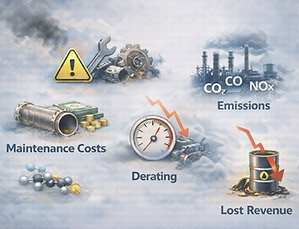
Impact on Performance & Value
-
Equipment downtime & reduced reliability
-
Increased maintenance costs and fouling
-
Engine derating and unstable operation
-
Higher emissions (CO, VOC, NOx, methane slip)
-
Lost revenue from unrecovered hydrocarbons
Field Gas Conditioning Systems for Production Facilities
What is needed is a field gas conditioning system to remove the water and heavy hydrocarbons and provide consistent, filtered and heated lean gas output that is a high-quality fuel for production facility equipment, along with an optional NGL or condensate output for additional revenue generation.

When considering improved equipment uptime, reduced maintenance costs, increased equipment longevity, improved environmental and safety compliance, and potential revenue from captured liquids, significant economic benefits can be realized through deployment of field gas conditioning solutions.
Pioneer Energy provides several Pegasus field gas conditioning systems that can meet this need. The Pegasus VC and Pegasus LP for larger pads are well suited to field gas conditioning for typical production facilities. When higher pressure gas is available including from the output of an on-site gas lift compressor, the Pegasus Mini HP can be an attractive and cost-effective option. In some circumstances, depending on fuel quality and conditioning requirements, a simple Gas Filtering, Heating & Manifolding Skid can also be an effective solution.

Features of Pegasus Field Gas Conditioning Systems
High Performance – Able to accept a wide variety of raw field gas compositions, each Pegasus unit will provide a lean, consistent, continuous output of high-quality fuel gas. The system adapts to changing supply and demand and is designed to prevent slugs reaching downstream equipment.
High Capacity – Units can operate stand alone or in parallel to provide the required fuel gas volume for production facility equipment.
High Availability – Proprietary software and robust hardware enable high availability for mission critical oilfield applications.
Robust Construction – Built to withstand rough oilfield environments.
Highly Mobile – Skid-mounted systems with quick disconnects designed for easy teardown, transport and setup.
Liquid Return or Optional NGLs – Ability to return liquid residue or stabilize NGLs onboard depending on configuration.
Autonomous Operation – Simple push-button controls minimize required field personnel attention.
Cloud Enabled – Real-time monitoring, diagnostics, and remote access via onboard SCADA systems.
Additional Functionality – Fuel filtration, heating and gas manifolding available as standalone or integrated modules.
Safe – Designed for full compliance with oilfield standards, including ASME and Class 1 Div 2, with rigorous HAZOP review.
